
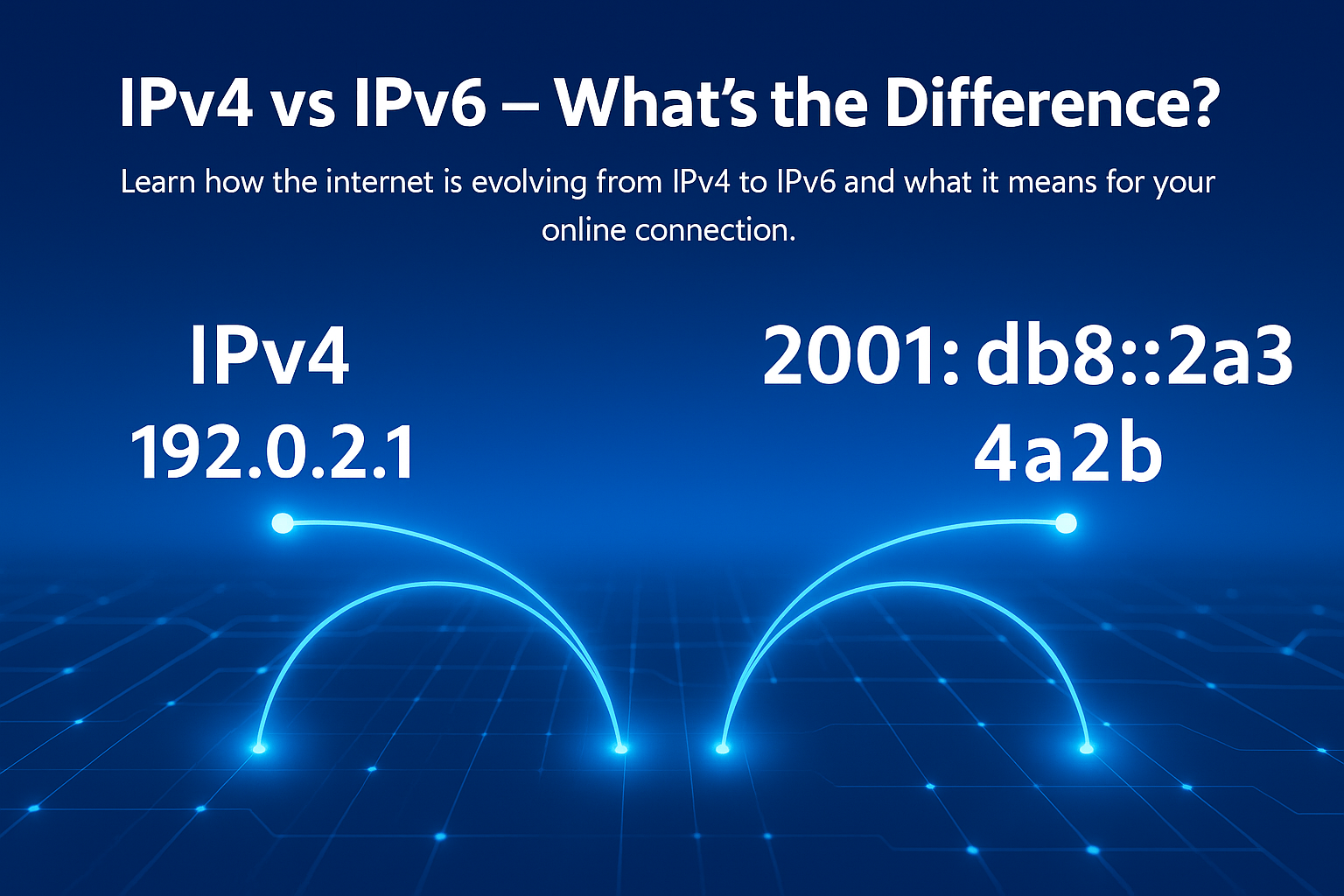
Every device connected to the internet needs an IP address — a unique numerical identifier that allows data to be routed correctly. But there are two very different versions of the IP address system in use today: IPv4 and IPv6. Understanding the difference matters for anyone interested in networking, privacy, or simply knowing what their IP address actually means.
What Is IPv4?
IPv4 (Internet Protocol version 4) was introduced in 1983 and has been the foundation of internet addressing ever since. An IPv4 address consists of four numbers between 0 and 255, separated by dots:
82.31.158.226
This format allows for approximately 4.3 billion unique addresses (2³²). In 1983, that seemed like more than enough. The entire global population was around 4.7 billion, and the idea of every person owning multiple internet-connected devices was unimaginable.
Today, it's a different story. Smartphones, tablets, smart TVs, smart watches, connected appliances, and billions of IoT sensors have created a demand for IP addresses that IPv4 simply cannot meet.
Why IPv4 Addresses Ran Out
The IPv4 address pool was officially exhausted at the global level in 2011, when IANA (the Internet Assigned Numbers Authority) allocated the last blocks to regional registries. Since then, obtaining new IPv4 address space has required purchasing it from organisations that hold unused blocks — at considerable cost.
The internet has been kept running through two main workarounds:
- NAT (Network Address Translation): Your router lets multiple devices in your home share a single public IPv4 address by keeping track of which device sent which request. This is why your home has one public IP address, but your laptop, phone, and smart TV all have their own private IP addresses within your home network.
- CGNAT (Carrier-Grade NAT): Many ISPs now place multiple customers behind a single shared public IPv4 address — adding another layer of address sharing at the provider level.
These workarounds work, but they add complexity, can cause problems for certain applications, and make it harder to trace network issues.
What Is IPv6?
IPv6 (Internet Protocol version 6) was developed specifically to solve the address exhaustion problem. An IPv6 address looks very different from IPv4:
2001:0db8:85a3:0000:0000:8a2e:0370:7334
IPv6 uses 128-bit addresses, written as eight groups of four hexadecimal digits separated by colons. This provides approximately 340 undecillion unique addresses — that's 340 followed by 36 zeros. In practical terms, it's enough to assign billions of unique addresses to every person on Earth. We will not run out of IPv6 addresses.
Key Differences Between IPv4 and IPv6
Address Space
IPv4 offers around 4.3 billion addresses. IPv6 offers 340 undecillion — effectively unlimited for any foreseeable future.
Address Format
IPv4 uses dotted decimal notation (192.168.1.1). IPv6 uses hexadecimal with colons (fe80::1).
NAT Requirement
IPv4 requires NAT to share addresses between multiple devices. IPv6 is designed to give each device its own globally unique address, making NAT unnecessary (though still possible).
Security
IPv6 was designed with IPsec (a suite of security protocols for encrypting and authenticating IP traffic) as a core component, though in practice its use isn't mandatory. IPv4 had security added later as an afterthought.
Configuration
IPv4 devices typically need to be assigned an address by a DHCP server (or manually). IPv6 supports SLAAC (Stateless Address Autoconfiguration), allowing devices to generate their own addresses automatically without a DHCP server.
Performance
IPv6 has a simplified packet header compared to IPv4, which in theory allows routers to process packets more efficiently. In practice, performance differences are rarely noticeable for end users.
IPv6 and Privacy: What You Should Know
IPv6 introduces some important privacy considerations that are worth understanding:
Persistent Device Identifiers
In early IPv6 implementations, addresses were derived partly from the device's MAC address (a hardware identifier built into your network card). This meant your IPv6 address could be used to track your device across different networks — a significant privacy risk. Modern operating systems now use privacy extensions that generate random, temporary IPv6 addresses to prevent this.
More Difficult to Hide Behind NAT
With IPv4, NAT means many users share one IP — making it harder to identify specific individuals. With IPv6, every device gets its own globally unique address. This is technically cleaner, but it makes per-device tracking easier unless privacy extensions are enabled.
VPN IPv6 Leaks
Many VPN clients only tunnel IPv4 traffic. If your connection also uses IPv6 and your VPN doesn't handle it, IPv6 traffic may bypass the VPN entirely — leaking your real IPv6 address to websites. This is a common form of VPN leak. Check whether your VPN supports IPv6 tunnelling, or disable IPv6 on your device while using a VPN.
Do You Currently Have an IPv6 Address?
Whether you have an IPv6 address depends on your ISP and router. UK adoption of IPv6 varies significantly — some providers like BT and Sky have deployed it widely, while others still use IPv4 with CGNAT. You can check your current address type on the GoIPScan homepage — it will show whether you're connecting via IPv4 or IPv6.
The IPv4 to IPv6 Transition
The internet cannot switch from IPv4 to IPv6 overnight — billions of devices, routers, and servers need to be updated, and many older systems only support IPv4. The transition has been ongoing for over a decade and will continue for years to come.
The most common approach is dual-stack: running IPv4 and IPv6 simultaneously on the same network. Devices that support IPv6 will use it when available; others fall back to IPv4. This is how most modern ISP connections work today.
Frequently Asked Questions
Do I need to do anything to support IPv6?
For most home users, no. If your ISP and router support IPv6, your devices will use it automatically. You don't need to configure anything manually.
Is IPv6 faster than IPv4?
Marginally, in some circumstances — primarily because IPv6 avoids the overhead of NAT translation. For everyday browsing, the difference is imperceptible.
Can IPv4 and IPv6 communicate directly?
No. IPv4 and IPv6 are fundamentally different protocols and cannot communicate directly. Translation mechanisms like NAT64 exist to bridge them, but they add complexity.
Should I disable IPv6?
There's no general reason to disable IPv6, and doing so may cause connectivity problems on modern networks. However, if you're using a VPN that doesn't support IPv6 tunnelling, disabling IPv6 while the VPN is active prevents potential IPv6 leaks.